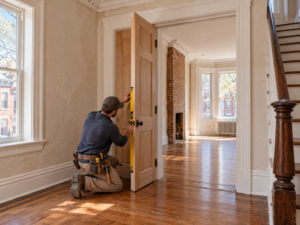
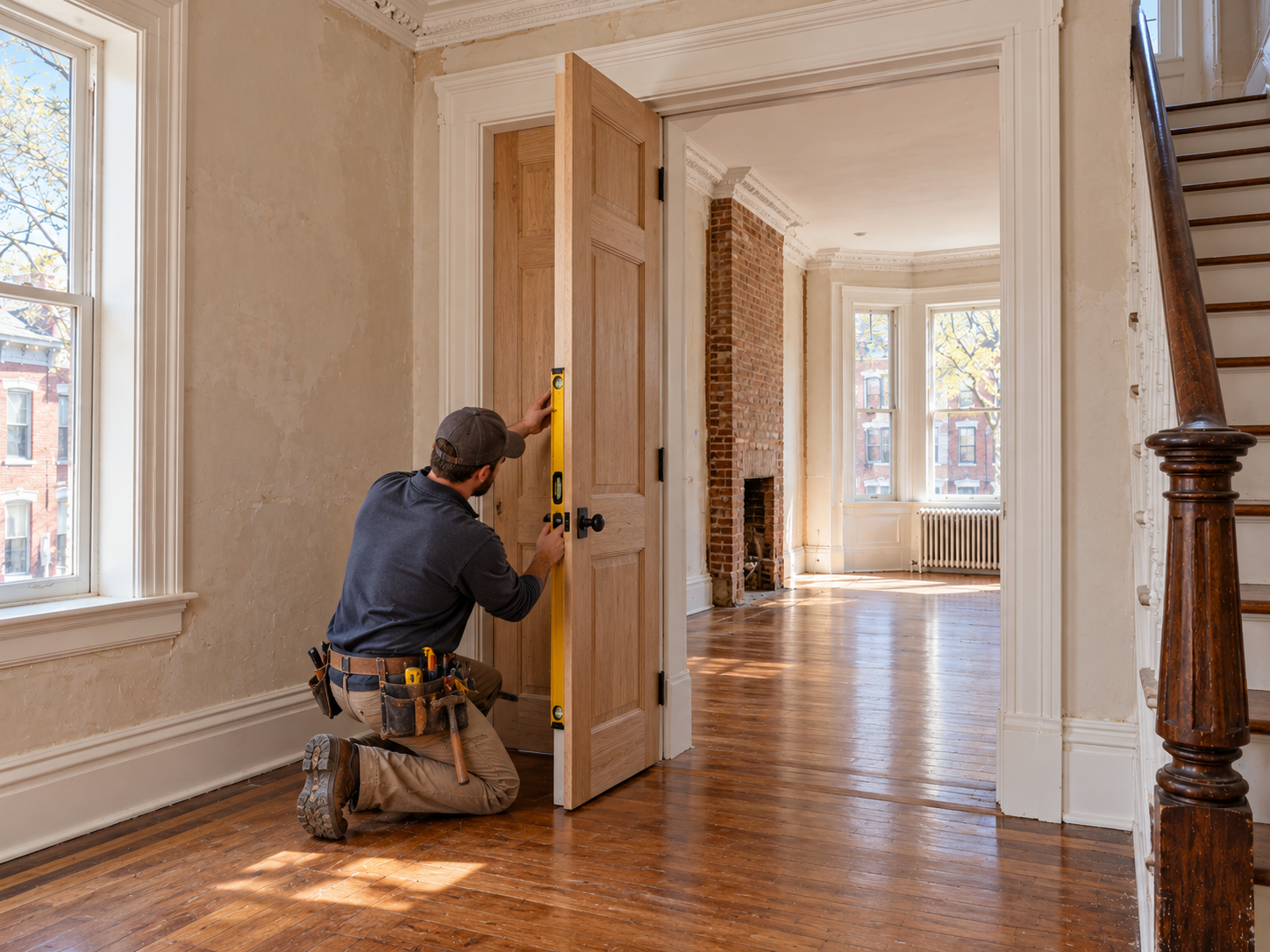
Replacing an interior door sounds simple until the new door arrives and the opening is not square.
Older Philadelphia row-homes frequently contain door frames that have moved slightly over decades of settlement, remodeling, flooring changes, plaster repairs, and repeated door replacements.
A new door slab may be perfectly straight while the existing jamb is not.
That is why a professional interior door replacement starts by evaluating the entire opening rather than measuring only the width and height of the old door.
Door Slab Replacement vs. Full Prehung Replacement
One of the first decisions is whether to replace only the door slab or remove the jamb and install a complete prehung door assembly.
A slab replacement preserves the existing frame.
This can work when the jamb is straight, secure, appropriately sized, and in good enough condition to receive new hinges and hardware.
A prehung replacement includes a new door mounted in a new jamb.
That approach may provide more flexibility when the old jamb is heavily damaged, twisted, poorly repaired, or incompatible with the new door.
PHS General Contractor’s home remodeling services can incorporate door replacement into larger room, flooring, trim, and interior renovation scopes.
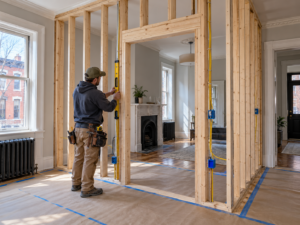
Old Openings Are Often Out of Square
A rectangular door should ideally sit in a square opening.
Older houses do not always cooperate.
One side of an opening may be slightly higher than the other. The floor may slope. The jamb may bow inward. Previous owners may have trimmed doors repeatedly to accommodate movement.
Simply installing a factory-sized slab without accounting for those conditions can create uneven gaps and poor operation.
Contractors typically evaluate plumb, level, square, and the relationship between the opening and the finished floor.
Flooring Changes Can Affect Door Height
New flooring is an easy detail to overlook.
If a renovation adds hardwood, tile, underlayment, or floating flooring, the finished floor elevation may rise.
A door that previously had adequate clearance may begin rubbing.
Conversely, removing thick flooring can create a larger-than-expected gap under the door.
Door work should therefore be coordinated with the final flooring plan.
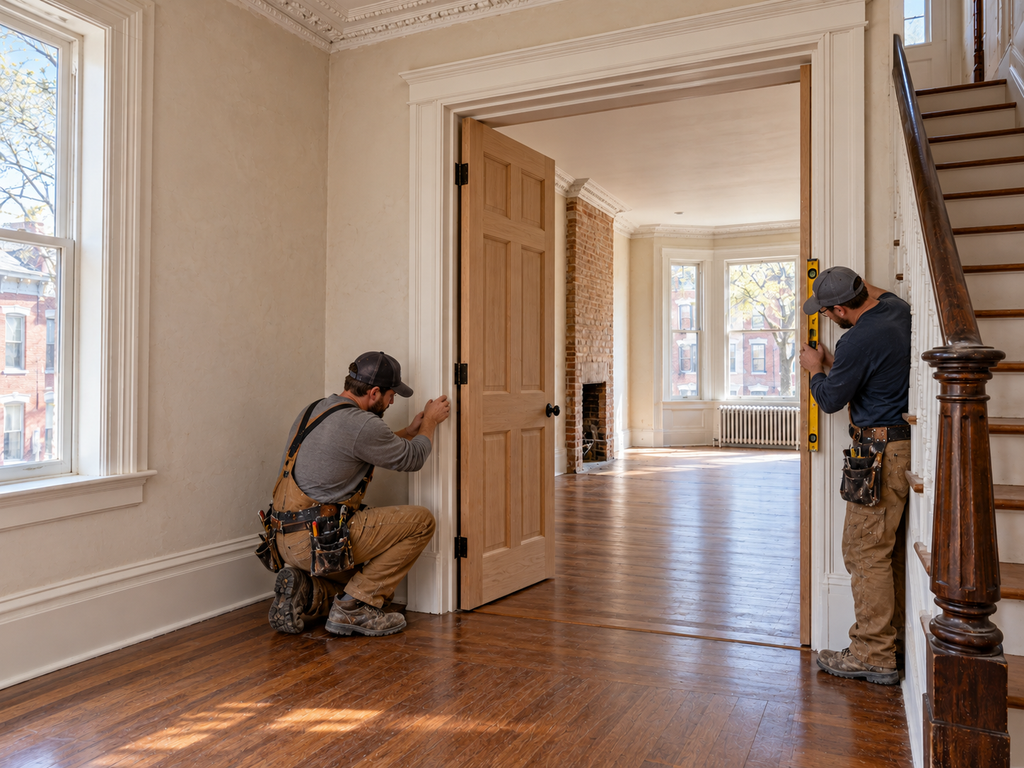
Casing and Baseboards Must Meet Cleanly
Replacing the jamb often affects the casing around the opening.
In an older Philadelphia interior, existing trim may have a profile no longer available at a standard home-improvement store.
The contractor may need to preserve existing casing, reproduce a similar profile, replace trim around the entire opening, or create a transition that looks intentional.
Baseboards also need to terminate cleanly into the new casing.
These small finish details strongly influence whether the door looks original to the room or obviously replaced.
Hardware Position Matters
Door knobs and hinges have standard conventions, but existing houses can contain unusual locations created by generations of repairs.
If a homeowner wants to preserve vintage hardware, the new door needs to be prepared accordingly.
Modern hardware may require different back sets or bore dimensions.
Closet doors, bathroom doors, bedrooms, and utility spaces may also need different privacy or passage hardware.
Do Not Forget Swing Direction
Door swing affects furniture, switches, circulation, bathrooms, and hallway space.
Replacing a door is sometimes an opportunity to correct an inconvenient swing—but reversing it can affect hinge locations, latch positions, trim, wall switches, and room function.
The decision should be evaluated before the new jamb is installed.
Lead-Safe Considerations in Older Homes
Door replacement can disturb painted jambs, casing, and adjacent walls.
In homes built before 1978, renovation work that disturbs painted surfaces may fall under applicable lead-safe requirements.
The EPA provides information through its Renovation, Repair and Painting Program.
A Door Is Finish Carpentry, Not Just a Product
The door itself may arrive from a factory.
The quality of the finished installation depends on field conditions: alignment, shimming, casing, hardware, flooring, wall thickness, paint, and the geometry of the existing opening.
That is why door replacement can become a meaningful part of a larger interior renovation.
FAQ
Can I replace only the door and keep the old frame?
Yes, when the existing jamb is in good condition and appropriately aligned.
Why does my old door close by itself?
An out-of-plumb jamb or sloped floor can contribute to the door moving when left partially open.
Should doors be installed before or after flooring?
The final floor elevation should be known before door heights and clearances are finalized.
Can original casing be reused?
Sometimes, especially when it can be removed without significant damage
If new doors are part of a Philadelphia interior renovation, PHS General Contractor can coordinate the openings, trim, flooring, and finishes so the replacement looks like it belongs in the home.